From Memorial to Mission
There was no master plan. There was a family carrying the loss of a son—and a decision to keep Brian's memory connected to opportunity, baseball and the people who came after him.
What began as remembrance became an annual tournament, a scholarship, youth-sports operations, permanent facilities and eventually a body of research asking larger questions about access, stewardship and accountability in youth sports.
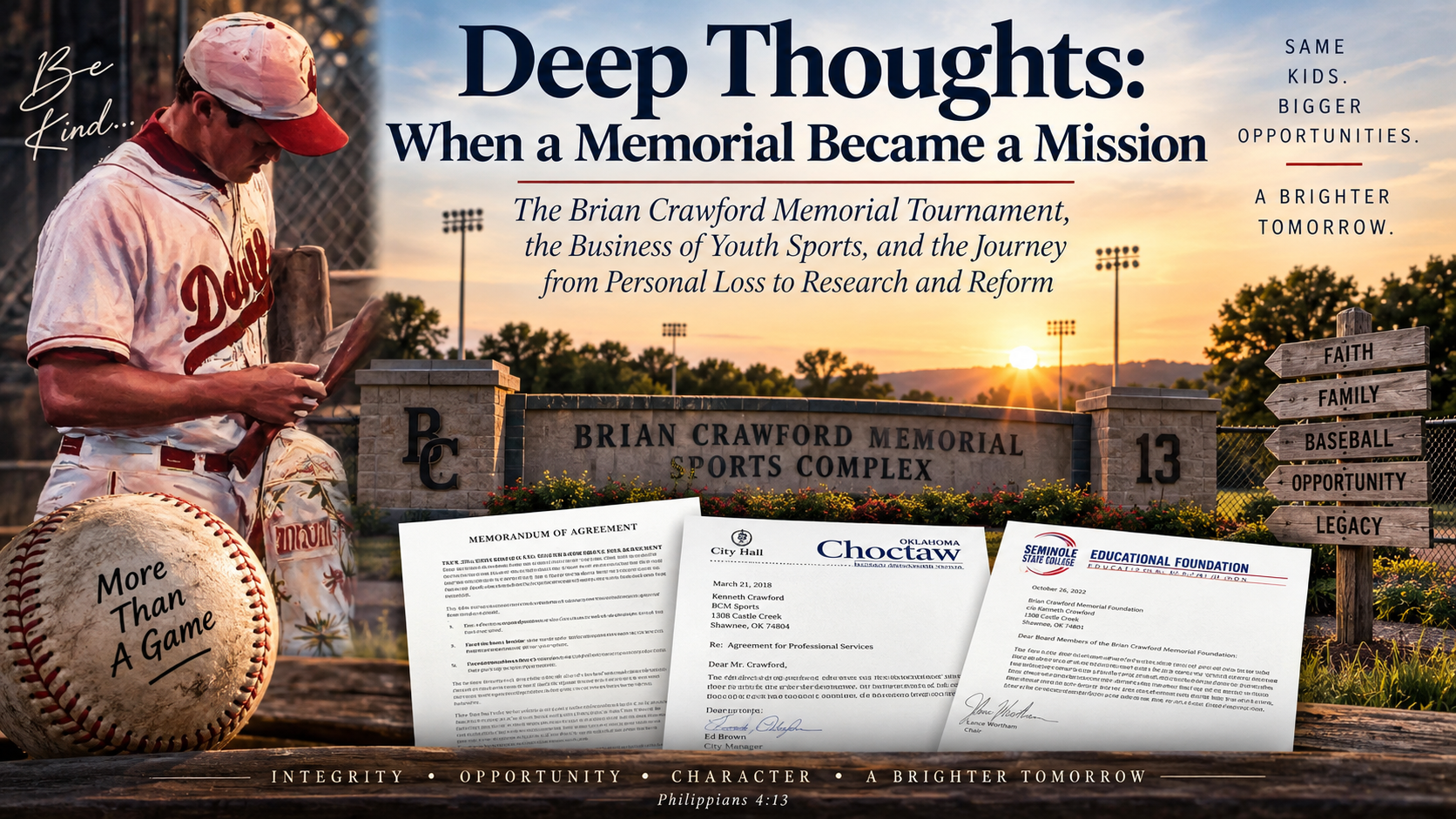
Faith • Family • Baseball • Opportunity • Legacy
Before there was a mission, there was Brian.
The larger story begins with Brian Allen Crawford—not with a tournament, organization, facility, dataset or research project.
After Brian's death in 2005, the Crawford family began creating ways to remember him and to give that grief somewhere constructive to go. The first Brian Crawford Memorial Baseball Tournament followed in 2006 at Shawnee's Lions Club Ball Fields.
In Kenneth Crawford's later first-person reflections, the annual tournament became something the family could work toward each year. It created a recurring place to talk about Brian, share his story, gather family and connect his memory with young athletes and baseball.
“It was a way for me to deal with the loss of Brian… Our family. It gave us something to work towards. Every year.”Kenneth Crawford • September 22, 2026 reflection
One act of remembrance opened into many forms of legacy.
Memorial Tournament
Seventeen annual editions carried Brian's name through baseball and across multiple Oklahoma communities. The tournament became both a family tradition and an operating education in facilities, officials, relationships and event economics.
Scholarship
The scholarship tradition began with a family-funded award in 2015. A permanent Brian Crawford Memorial Scholarship Fund was formally established through Communities Foundation of Oklahoma in 2016.
BCM Sports
BCM Sports extended the Memorial experience into league and tournament operations at public facilities, including the documented Bouse Sports Complex chapter in Choctaw.
Memorial Sports Complex
The Brian Crawford Memorial became a lead contributor to the Seminole project that developed into a seven-field complex carrying Brian's name, with the facility reaching its grand-opening period in 2022.
Brian Crawford Memorial Field
Brian's hometown became another permanent memorial location when a youth baseball field was named for him and the Crawford family invested in an artificial-turf infield and memorial presence.
Family & Community Archive
Tributes, photographs, music, memorial service records and personal recollections preserve the person behind every later project: Brian Allen Crawford.
The mission changed because the questions changed.
Years of tournaments and facility work produced experiences that could not be explained by memorial history alone.
Operate
Organize tournaments, schedule fields, recruit officials, work with facilities and serve teams.
Observe
See how access, contracts, user groups, fees, concessions, officials and relationships affect what happens on the field.
Document
Preserve agreements, public records, historical files, datasets and first-person accounts rather than relying on memory alone.
Research
Ask broader questions about public facilities, governance, financial flows, community access and accountability.
Important distinction: The later research does not redefine Brian's memorial as a dispute. It documents how experiences encountered while carrying out the Memorial mission generated questions that eventually became a separate research and reform effort.
The story now lives across three different archives.
Each website preserves a different part of the same history. Keeping those roles distinct allows Brian's personal legacy, the operational experience and the later research to remain connected without becoming interchangeable.
Brian Crawford Memorial
Brian's life, family memories, music, tributes, Memorial Tournament, scholarship, permanent memorial sites and the continuing legacy created in his name.
BCM Sports
The leagues, tournaments, facilities, officials, operating systems and community programming that placed the Memorial mission into active youth-sports operations.
Baseball Heaven
The historical archives, public records, datasets, case studies and statewide research that grew from questions encountered across decades of youth-sports experience.
Baseball Heaven preserves the deeper analytical record.
The Memorial website tells the human and legacy story. Readers who want the detailed documentary and research history can continue into the Baseball Heaven archive, where the underlying operational chapters, source distinctions and research evolution are examined in greater depth.
When a Memorial Became a Mission
The comprehensive first-person reflection and primary-document bridge connecting the Memorial Tournament, facility experiences, business lessons and later research mission.
History & Archives
The chronological documentary architecture connecting the Oklahoma Braves, Memorial Tournament, BCM Sports, Seminole planning records and the later research evolution.
Community Asset Stewardship
The prospective research phase asks how community access, facility stewardship, transparent finances and long-term mission protection might be aligned for future generations.
The Memorial remains the reason. The research is what followed.
This page is a bridge, not a claim that every later research conclusion was understood at the beginning. The historical record shows a sequence: personal loss, remembrance, tournament operations, scholarships, facilities and nonprofit work came first. The larger research questions developed later.
That chronology matters. It preserves Brian's memorial as its own story while honestly documenting how the experience of carrying that mission through youth sports eventually changed the direction of Kenneth Crawford's work.
The tournament stopped. The mission did not.
Brian's legacy continues through family memory, scholarships, the facilities carrying his name, the people who knew him and the opportunities created in his memory. The later research is another chapter—not a replacement for the Memorial, but one of the places the journey ultimately led.